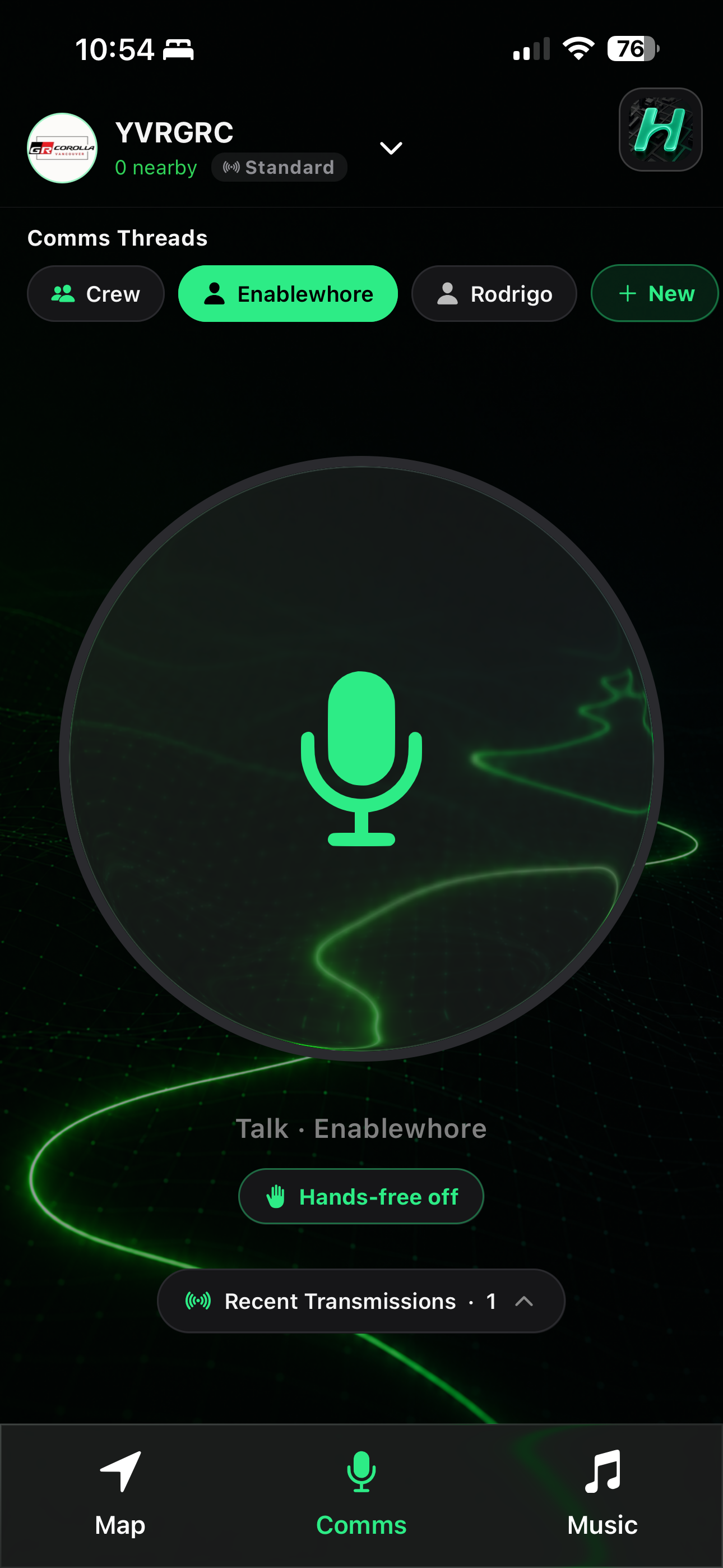
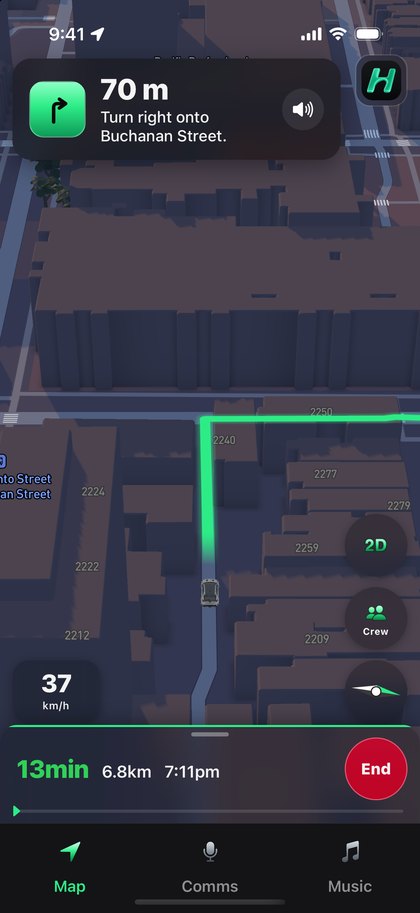
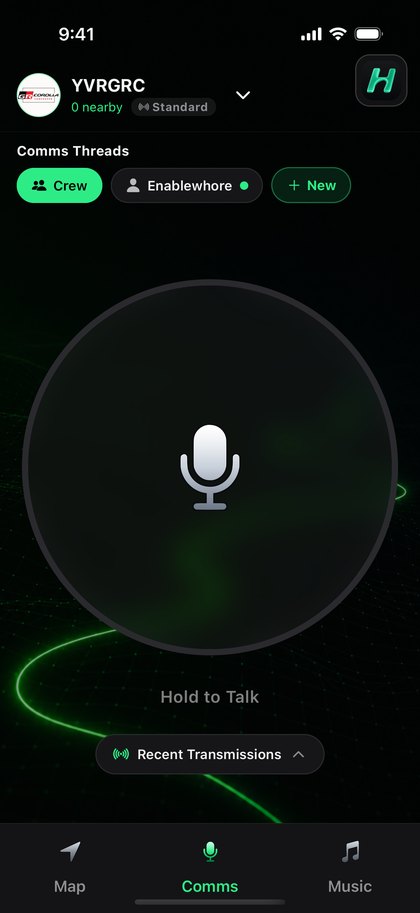
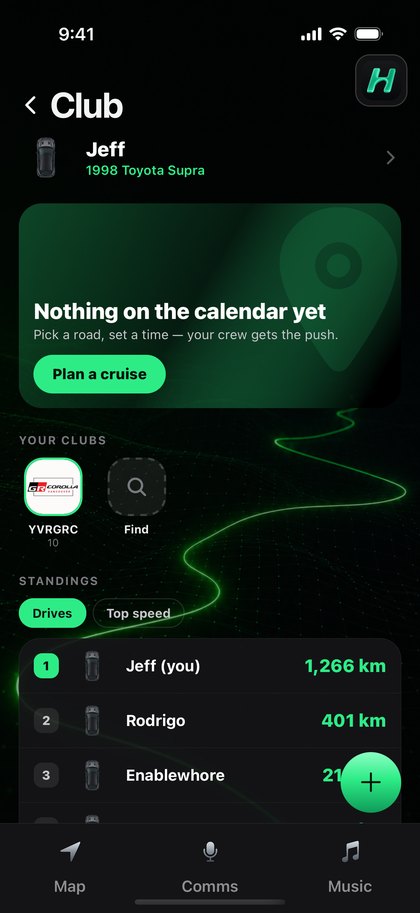
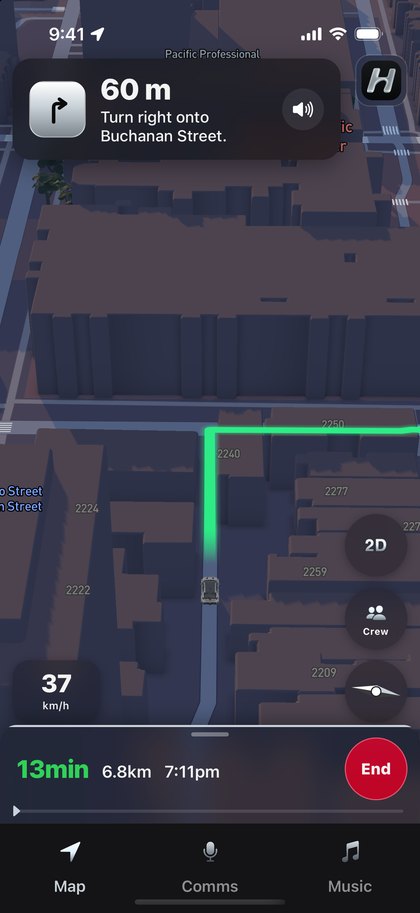
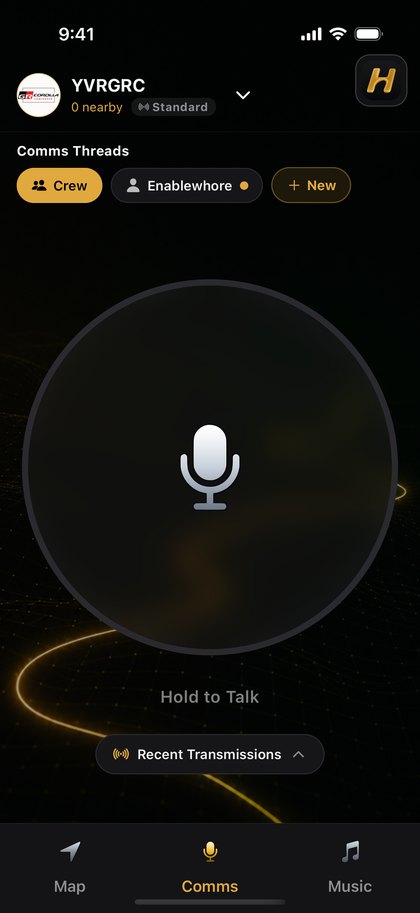
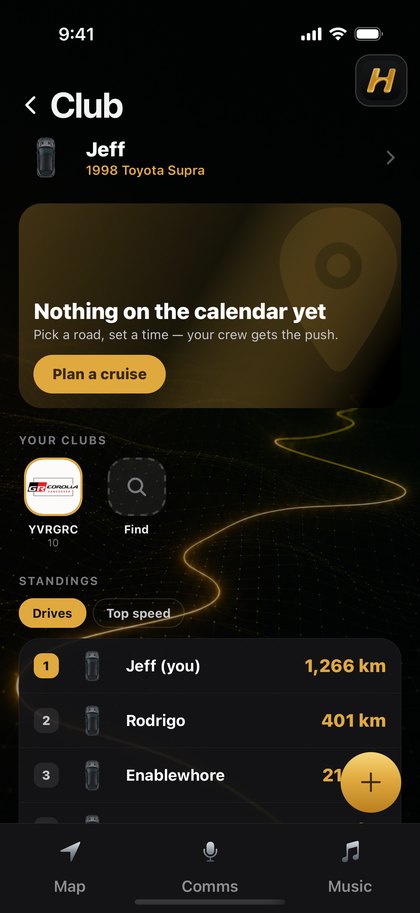
Every car in the convoy, live — position, speed, and spacing on a shared route. Fall behind and the crew sees it. Someone reroutes and everyone knows. It's the group chat, except it's a map and nobody has to type.
Scout isn't a voice menu — she's an agent. Ask her something and she checks the convoy, scans the hazards, sets the route, tells the crew — then answers out loud. From the app, the CarPlay mic, or straight off the steering wheel: "Hey Siri, ask Scout…"
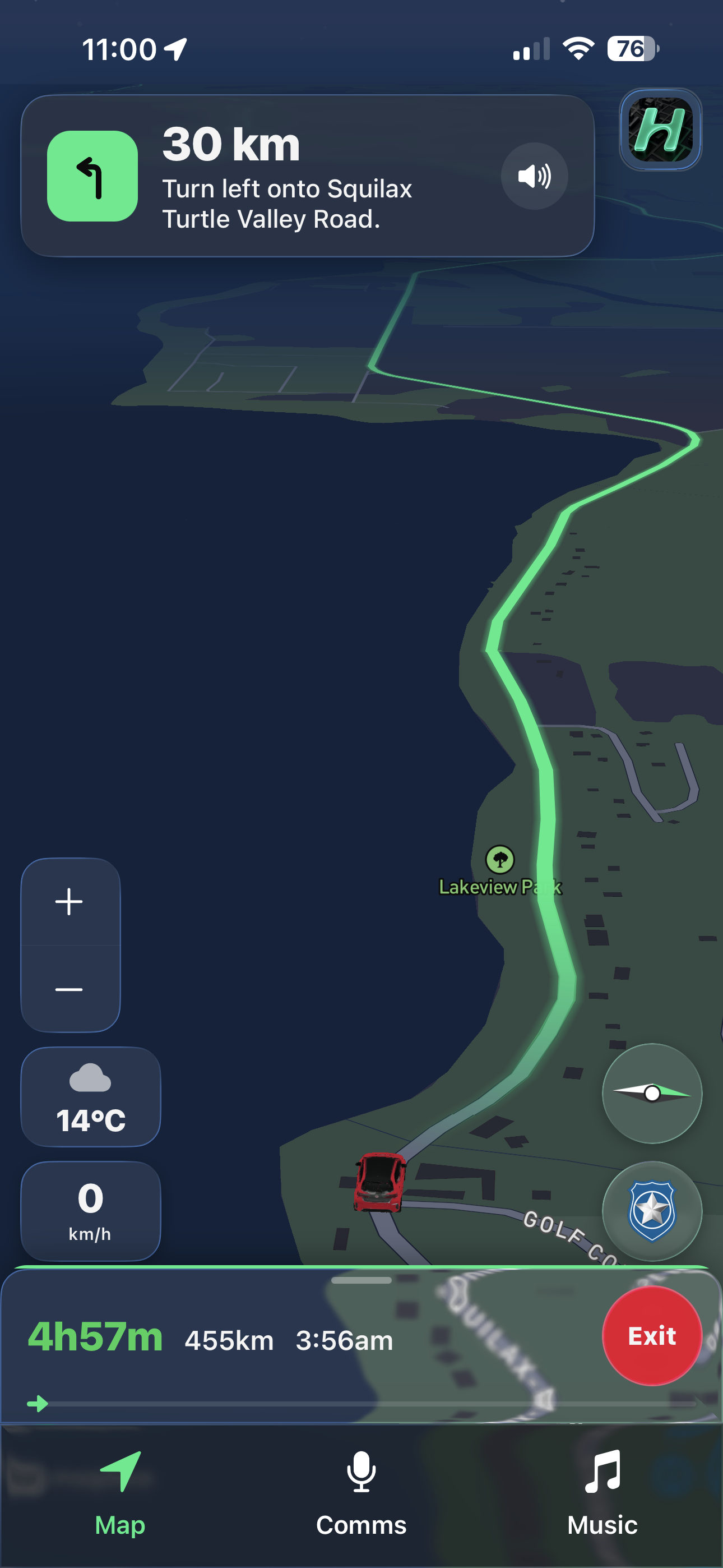
Starts navigation, reports hazards, messages the crew — multi-step, from one sentence.
Live positions, spacing, and who’s fallen behind — she’s watching so you don’t have to.
Phone hold-to-talk, a mic button on CarPlay, and the steering-wheel button via Siri.
Ducks the music while she speaks, never over your co-driver’s hot take.
Hold the button and talk like a person. Whisper turns what you said into text — then Claude works out what you actually meant and goes and does it: set the route, drop a hazard, find the gas, tell the crew. Not a phrase list. Something that reads the sentence.
Both run server-side, so no AI keys ever ship inside the app. And if the model can’t be reached, Scout drops to an on-device classifier — the mic still works when the internet doesn’t.
Every big map sends you the fastest way. Hairpin watches the way you actually go — the back road you always take, the junction you always avoid — and remembers the shape of it. Set off again from the same neighbourhood and it rebuilds your route, with live traffic on it, even when it isn’t technically the quickest.
This half is not a chatbot and not a server. The path you drove is kept on your device and replayed as real waypoints — which is why it knows your commute, and why nobody else ever sees it.
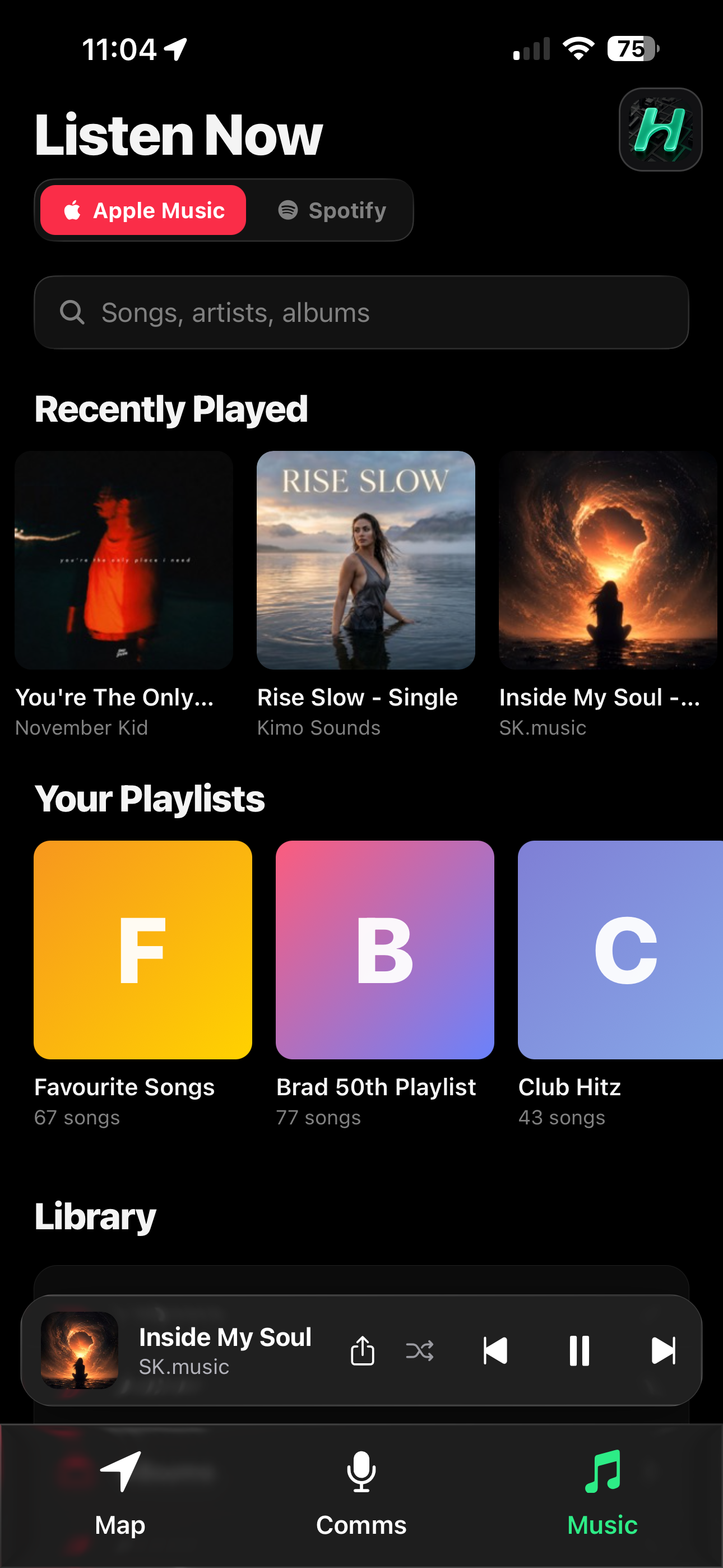
Apple Music or Spotify, right in the app — then push the track you’re playing to everyone driving with you. Same song, same moment, no group text.
Bring your own library — search, playlists and Listen Now, native in the app.
Share the current track and everyone taps in — same song, same drive.
The music dips when Scout speaks or a transmission comes in, then rolls right back.
One tap — or one sentence to Scout — drops a report the whole community sees. Confirmations keep it honest; stale reports expire on their own. Plus official incident feeds and speed alerts that nudge, not nag.
Voice-report from the wheel. Everyone behind you gets the callout.
Know before the brake lights. Scout calls out what's ahead on route.
Potholes, gravel, that mattress in lane two — flagged for the crew.
Route lines shade green→amber→red with real traffic, phone and CarPlay.
Not a shrunken phone app — the same live convoy, 3D drive view, congestion-shaded route, speed limits and Scout, matched to the phone pixel for pixel. Pinch to zoom. Tap the mic. Drive.
Walk one lap around your car with the phone. Four photos go up, a 3D model comes back, and the shape driving the map is yours — not a stand-in. The same car shows up on the phone, in CarPlay and on Android Auto.
This is the actual GLB the app renders in your Garage — not a picture of it. Drag to spin, scroll to zoom.
The capture · one clockwise lap
Four is not a starting point to grow from — it is the reconstructor's actual input shape. It exposes exactly four slots and wants them orthogonal: straight-on, never three-quarter. Three-quarter frames pushed into those slots rebuild worse, and the one six-view run that was tried failed outright. The lap runs clockwise so you never backtrack.
000°slot Front
Square to the nose. Centre the badge.
090°slot Right
Square to the flank. Both wheels in frame.
180°slot Back
Square to the tail. Centre the plate.
270°slot Left
Square to the flank. Both wheels in frame.
Every frame is handed over by slot — front, back, left, right — carried in the scan's own manifest, never by filename. The lap numbers the files in walking order instead, so feeding the same four straight through in file order builds the car mirrored, with no error to tell you.
Capture discipline
None of these are preferences. Four of these six are the coaching lines the app itself shows you on the way round; every one is a failure mode that was measured on a real car first.
Framing
Orthogonal, not three-quarter. The reconstructor wants each face square-on; a 3/4 frame in an orthogonal slot rebuilds worse.
Distance
Stand three to four metres back and use the 1× lens — pinching to zoom or stepping in warps the proportions.
Height
Hold the phone at head height, tilted slightly down. The map's camera looks at the roof and hood.
Light
Even light. Open shade or overcast beats direct sun; hard shadows get baked into the paint.
Subject
Nothing leaning on the car, doors and windows shut, wheels pointed straight ahead.
Resolution
Frames upload at native resolution on purpose. Downscaling costs reconstruction detail, which is the whole point.
The output · two models, one scan
The Garage hero is rendered in a WebView, so it can be heavy. The map twin has to survive a live 3D map on a phone that is also navigating — so it is decimated to a spec, and the spec is not negotiable.
| Property | Map twin | Garage hero |
|---|---|---|
| Face limit | 20,000 | 150,000 |
| Texture | 1024 px | 2048 px |
| Index width | u16 — required | unconstrained |
| Vertex budget | under 25,000 | not gated |
| Draws through | Mapbox — phone, CarPlay, Android Auto | WebView |
The ceiling
65,536
vertices per mesh — the u16 limit. Past it the format flips to u32 indices, and a u32 car is invisible on Mapbox: no error, no warning, no car. Mapbox's own guidance for an ego vehicle is under 25,000 vertices, so the twin is decimated to land there with margin.
Fleet convention
Scanned or hand-authored, every car in the fleet is normalised to the same numbers before it ships.
Measured · first real scan
Smaller file, lighter mesh, cleaner panels than the car a human built by hand. That was the point at which the pipeline stopped being an experiment.
The pipeline
One clockwise lap. Four orthogonal frames, full resolution.
Write-only to the world. Insert is the only policy; there is no public read.
A single server-side function issues time-limited signed links. Nothing else can read.
The four slots go to the 3D service as multi-view input and come back as geometry.
Map twin published first, hero last — the hero is the completion signal.
The app is already polling. It sees both files and flips itself over.
The ready flip is one write. The map, CarPlay, Android Auto and the Garage all subscribe to it — so your car lands on every surface in the same instant. No restart. No force-quit. Each render carries its own id, so a rescan swaps the car live and no cache can pin the old one.
The honest part
Two renders
You get two. The second replaces the first, and the first cannot be brought back — even if you liked it more. That is said on the consent screen before the first photo, not at the moment it bites.
It will not be an exact replica
Your car is rebuilt from four photos. Badges, grilles, wheel spokes and trim can come out simplified or wrong. It will read as your car; it will not survive a close inspection.
Where the photos go
Into a private, write-only bucket — no public read, ever. Reads happen only through a server-side door holding time-limited signed links. The photos are passed to an outside 3D service to build the model, and the consent screen says so before you take the first frame.
Garage Scan is part of Ultra Premium, and it is still rolling out — the capture is in the app, the pipeline behind it is being finished ahead of the store launch. Tiers arrive with that launch too; nothing in the app is locked today.
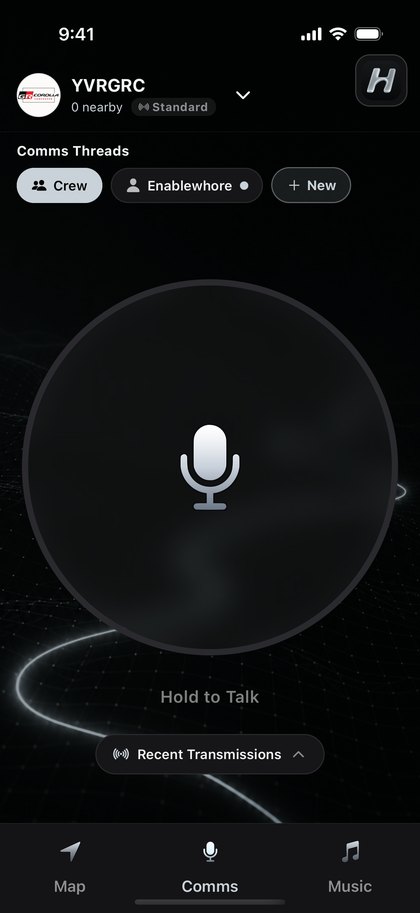
Walkie-talkie for the convoy — live voice between cars, no phone numbers, no group call.
Apple Music & Spotify built in. Push a track to the whole crew mid-drive.
Best, Scenic — and an AI route that learns the way you actually drive home.
Tap a crew member's car and route straight to them, wherever they are.
Four photos, one lap around the car, and the 3D model driving the map is yours — not a stand-in. See how it's built →
One switch, one honest trade — lighter GPS at about 10 m accuracy instead of 4 m. For the long drives without a charger.
Free isn't a trailer — it's the live map, your crew, push-to-talk, community hazards, turn-by-turn, CarPlay and Android Auto. Premium and Ultra Premium buy the parts that make it yours. Nothing is locked today: every tier is switched on while we're testing, and the split arrives with the store launch.
Free now. Free at launch.
Everything in Free, plus
Unlocked for every tester right now. Premium goes on sale at the store launch.
Everything in Premium, plus
Everything else in Ultra Premium is unlocked for every tester right now. Garage Scan is still rolling out. Ultra Premium goes on sale at the store launch.
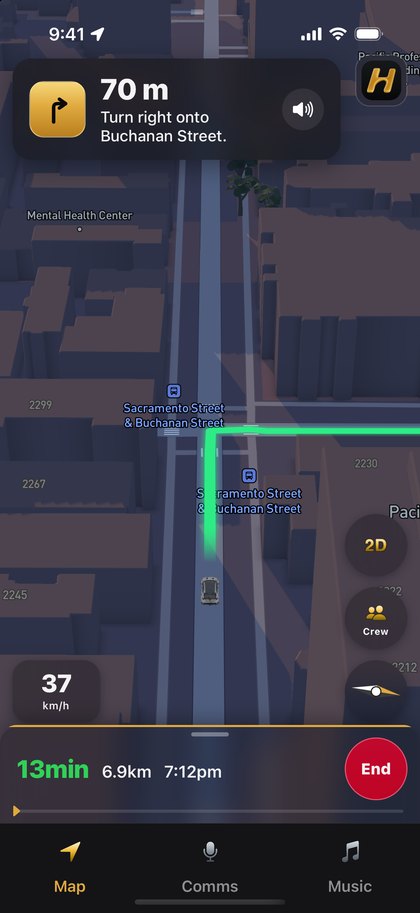
Premium turns Hairpin silver. Ultra Premium turns it gold — the chrome all the way through: the map's buttons, the turn square in the drive banner, the tab bar, the Hairpin mark in the corner. (The wordmark and the home-screen icon stay green. Brand marks survive their themes.)
It ships set to Automatic, so the metal simply arrives the moment the tier does and there's nothing to go and find. The metal arrives with the tier; the choice is what Ultra buys.
Picking your map marker picks the metal with it — Arrow is green, Class is silver, 3D is gold.
| Tier | App skin | May switch to |
|---|---|---|
| Free | Green | — |
| Premium | Silver | Green |
| Ultra Premium | Gold | GoldSilverGreen |
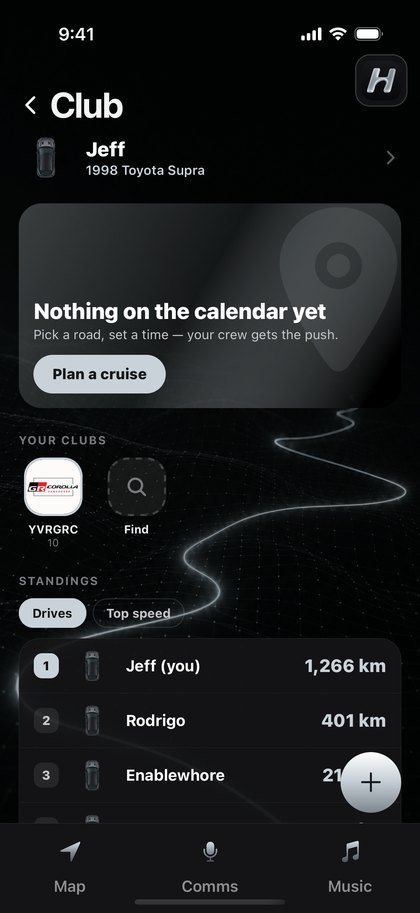
The same three screens in all three metals — real screenshots from the app, not mockups. Nothing changed between these rows except the skin.
Look along the Map column. The turn square, the H tile, the Crew button, the compass and the tab bar all step green → silver → gold — and in all three the route line is still brand green, because our gold lands between the map’s own slowing and congested colours and a gold route would read as traffic ahead, at speed. Chrome wears your metal. Meaning doesn’t.
What the skin never touches: the route line, the congestion shading, hazards and speed-camera pins stay brand green at every tier. Our gold lands between the map's own slowing and congested colours — a gold route line would read as traffic ahead, at speed. The destination and stop pins stay green too — they belong to the route. And a tier lock never wears your metal, only the feature's: if the whole app is already gold, a gold H stops selling anything. Some things aren't decoration.
Founding members of the GRC club and the original beta testers rank above all three — nothing is locked for them.
Sign-ups aren’t open yet — testers are joining by invite while we finish the beta.
Free while in testing · Android via Play internal testing · CarPlay & Android Auto · iOS 16+